1. Introduction
This study is based on the premise that the Bioeconomy can serve as a pathway for developing the Creative Economy (CE) in countries of the Global South. The Bioeconomy encompasses economic activities that rely on renewable biological resources to produce food, bioenergy, and biodiversity-based products (European Commission, 2012) and demands the management of creativity and innovation as sources of competitive advantage (Barney and Hesterly, 2019; Emmendoerfer et al., 2018), These biological resources are predominantly located in Global South countries, which are marked by socioeconomic inequalities, colonial legacies, historical dependence on extractivism, and the abundance and diversity of natural resources (Gray and Gills, 2016; Caldeira, 2016; Hickel et al., 2022).
Creativity and innovation are serving as sources of competitive advantage and fundamental to value creation. These activities often arise at the intersection of two or more economic sectors, frequently drawing on natural resources or their reuse to generate new businesses and economic opportunities. This dynamic is particularly evident in countries of the Global South, where it often represents both a survival strategy and an opportunity for socioeconomic advancement.
The Resource-Based View (RBV) theoretical framework emphasizes that an organization’s sustainable competitive advantage derives from value creation resulting from the combination of resources, skills and capabilities (Penrose, 1959; Dierickx and Cool, 1989; Barney, 1991; Peteraf, 1993; Teece et al., 1997; Winter, 2003). Building on this perspective, the Natural Resource-Based View (NRBV), proposed by Hart (1995), underscores that organizational strategies must incorporate environmental considerations. Hart (1995), Hart and Dowell (2011) argued that future sources of competitive advantage would increasingly depend on resources and capabilities aligned with environmentally sustainable economic activities.
This perspective is rooted in the principles of sustainability outlined in Agenda 21 (United Nations, 1992) and later incorporated into business practices through Elkington’s (1997; 2018) Triple Bottom Line framework. This model proposes that organizations evaluate their outcomes across three interrelated pillars: environmental, social, and economic. Business sustainability, under this framework, is achieved by balancing performance across all three dimensions. Over time, this approach has informed the development of new business models in which environmental and social performance are considered as critical as economic results.
Additional dimensions of sustainability have emerged, prompting broader consideration of how to realign the relationship between business and society. This evolution gave rise to the strategic management for sustainability approach, which examines the impact and significance of intra-organizational actions concerning broader economic, environmental, social, spatial, cultural, political, and knowledge-production contexts (United Nations, 1992; Montibeller Filho, 1993; Kruel, 2010; Costanza et al., 2014; Rhodes and Fleming, 2020; Negrão et al., 2024).
The relationship between businesses and clients, as well as organizational competitive advantage, is increasingly assessed through value creation, not only in economic terms (Ito et al., 2012) but also through the value generated by resource transformation along the value chain (Barney, 1991; Bowman and Ambrosini, 2000) and the capture of this value in consumer well-being and environmental outcomes (Brito and Brito, 2012; Costanza, 2014). However, the literature has primarily focused on medium and large enterprises, leaving a gap concerning small businesses (Maldonado-Guzmán et al., 2009; Negrão et al., 2024). These considerations also align with the creative economy’s , fostering potentially more equitable resource-based practices within the creative economy to promote more equitable and responsible development in the Global South (Sternberg, 2016; O´Connor, 2019).
In the context, the theoretical framework of sustainability strategies proposed by Negrão et al. (2024) is adopted, which stems from an analysis of small and medium-sized creative economy enterprises in the Amazon region. This choice reflects the understanding that strategic thinking aimed at organizational survival has historically been a continuous process, and the challenge becomes more complex when the pursuit of economic outcomes must also address social, environmental, legal, cultural, historical, and political dimensions. Accordingly, the research question guiding this study is: What empirical evidence exists regarding sustainability strategies in organizations operating within the creative economy in Global South regions such as the Amazon?
Addressing this question, the study adopts sustainability strategies as its theoretical framework. The following sections outline the methodological choices, present the empirical findings, and discuss their implications for future research on the Bioeconomy and sustainable development, reinforcing the premise outlined above. This discussion is particularly relevant to Global South countries and to actors seeking to foster more just and responsible relations with them.
2. Strategies for sustainability in the creative economy context
The Creative Economy (CE) encompasses economic practices aligned with the Bioeconomy, requiring sustainability strategies that integrate the multidimensional use of natural resources to promote sustainable development. However, studies examining this intersection remain limited. Strategic management for sustainability is increasingly recognized as part of the contemporary organizational agenda, including within CE organizations, as reflected in initiatives such as the UNESCO Creative Cities Programme. Established in 2004 and aligned with the 2030 Global Agenda, this program covers eight creative fields: gastronomy, music, media arts, film, design, literature, architecture, crafts and folk arts (UNESCO, 2025).
Several scholars have emphasized the critical role of organizations in addressing the sustainability challenge (Hart, 1995; Hart and Milstein, 1999; 2004; Bansal, 2002; Dyllick and Hockerts, 2002; Hahn et al., 2010). Over time, some institutions began adopting environmentally mandated practices, often requiring significant upfront investment. These practices were frequently perceived as either unnecessary expenses or regulatory obligations, or alternatively as opportunities. However, the deeper essence of sustainability was not yet fully understood (Hart, 1995). Organizational sustainability, particularly within firms, extends well beyond regulatory compliance.
Strategic management for sustainability encourages reflection on the impact and significance of intra-organizational actions, particularly concerning resources and capabilities as described by the Natural Resource-Based View (Hart, 1995; Hart and Dowell, 2011), and their broader external context, which includes economic, environmental, social, spatial, cultural, political, and epistemological dimensions of sustainability (United Nations, 1992; Montibeller Filho, 1993; Kruel, 2010; Costanza et al., 2014). In this context, Negrão et al. (2024) introduce the Sustainability Strategies Framework, shown in Figure 1.
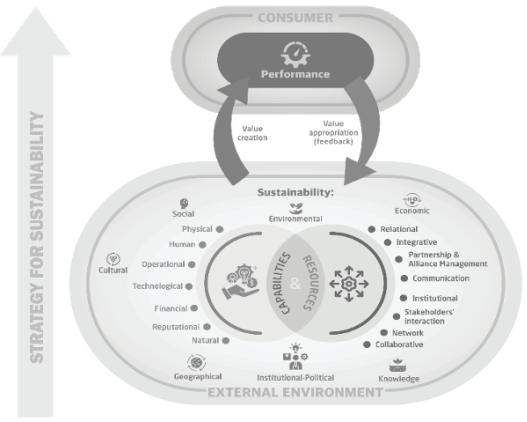
The proposed framework suggests first identifying the resources and capabilities available within the organization and classifying them according to the principles of the NRBV as a strategic directive. Managers are then encouraged to reflect on how the dimensions of sustainability can be integrated into strategies involving intra-organizational resources and capabilities. Once a specific context of organizational action is identified, the focus shifts to delivering products or services to consumers. At this stage, it becomes essential to consider how to generate value for the organization and enable its appropriation by consumers, not only from an economic perspective but also in terms of the well-being delivered to consumers and the fulfillment of the organization’s sustainable mission. This approach fosters a mindset oriented toward creating and appropriating sustainable value (Negrão et al., 2024).
2.1 Natural resource-based view
The Resource-Based View (RBV) is grounded in the premise that the combination of an organization’s resources and capabilities determines its strategic choices to achieve differentiation and competitive advantage (Wernerfelt, 1984; 1995; Peteraf, 1993; Barney, 1991; Amit and Schoemaker, 1993). The Natural Resource-Based View (NRBV), proposed by Hart (1995), extends RBV by incorporating the environmental dimension, which was initially overlooked, into organizational strategy formulation. Hart emphasized that in the coming years, strategy and competitive advantage would depend increasingly on resources and capabilities that support environmentally sustainable economic activities (Hart, 1995; Hart and Dowell, 2011; Hart and Milstein, 1999; 2004).
Applying the RBV framework throughout the organization helps managers identify and manage resources and capabilities within each unit. This approach enables the development of tailored departmental strategies that address specific contexts while maintaining an overarching
organizational vision oriented toward achieving strategic goals and objectives.
2.1.1Resources
According to Barney (1991), an organization’s resources encompass all tangible and intangible assets, both human and non-human, that are owned and controlled by the firm, enabling it to add value to its products and services. The author identifies three primary categories of resources: physical, human, and organizational. Grant (1991) expands this classification by incorporating technological, financial, and reputational resources, as shown in Table 1.
Table 1
Organizational Resources
[i] Source: Negrão et al. (2024).
According to Barney (1991), an organization’s resources encompass all assets, capabilities, processes, attributes, information, and knowledge under its control. The capabilities within organizations refer to “the ability of a bundle of resources to perform a task or activity” (Grant, 1991: 119). Grant’s (1991) propositions emphasize two key aspects. First, among the various resource bundles, special emphasis is placed on intangible resources, with personal skills considered strategic assets. Thus, intangible resources and capabilities are seen as potentially more enduring than the tangible resources upon which organizations were initially established and should therefore receive greater managerial attention.
The second aspect concerns Grant’s emphasis on the importance of cooperation and coordination among the firm’s resources and capabilities. According to the author, the greater the complexity involved in coordinating these elements, the less likely it is that competitors will successfully imitate the firm’s models due to limited access to complete information and a lack of transparency. This difficulty is further reinforced by the immobility of specific resources, such as those tied to geographic location or characterized by imperfect information, particularly in the case of human resources and firm-specific assets.
2.1.2 Capabilities
Capabilities refer to the firm’s ability to develop, combine, and apply its resources within organizational processes to achieve desired outcomes (Amit and Schoemaker, 1993). Table 2 presents the classification and definition of selected capabilities from the perspective of the RBV and the NRBV.
Table 2
Organizational Capabilities
| Capacity | Definition | Authors |
|---|---|---|
| Relational | Relational capability is a dynamic organizational ability developed through networks, enabling firms to achieve superior gains by aligning shared objectives among participants. Daily routines reinforce firm integration, offering long-term benefits and building sustainable competitive advantage, particularly through enduring collaborative relationships. Continuous information exchange among participants supports the achievement of common goals. | Capaldo (2007); Czakon (2009); Rodríguez-Díaz and Espino-Rodríguez (2008); Castro (2016); Paulraj (2011); Hidayah (2016) |
| Integrative | Integrative capability enables organizations to interact effectively with their operational context, facilitating the acquisition of critical resources and the development of innovative competencies. By integrating resources, companies promote information flows that benefit themselves and their partners, transforming operational strengths into sustainable competitive advantage and supporting proactive strategic initiatives. | Rai et al. (2006); Dangelico et al. (2013); Vanpoucke et al. (2014); Hartmann and Germain (2015); Jiang et al. (2015); Castro (2016); Li et al. (2017) |
| Partnerships and Alliance Management | Alliance management capability refers to a structured collaboration between partners, each contributing unique competencies that enhance the value of the partnership. This capability integrates coordination routines and transformational processes, which are critical for effective alliance management. | Lemmetyinen and Go (2009); Schilke and Goerzen (2010) |
| Communication | Communication capability comprises shared knowledge and information that enhance stakeholders’ competitive advantage. | Woo et al. (2016) |
| Institutional | Institutional capability refers to the identification of opportunities that arise when companies act collectively. | Spekkink (2015) |
| Stakeholders’ interaction | Stakeholders’ interaction capability reflects the ability to communicate and learn from stakeholders, combining stakeholder dialogue and knowledge interaction. | Veldhuizen et al. (2013) |
| Network | Network capability enables companies to facilitate knowledge sharing among partners, promoting rapid information transfer and fostering growth and innovation. Strategic interactions allow firms to leverage partner resources, adding value even in dynamic market environments. | Ziggers and Henseler (2009); Albino et al. (2016); Ryan (2012); and Mu (2013) |
| Collaborative | Collaborative capability generates economic value for networks by leveraging dynamic resources to maximize effectiveness. It enhances competitiveness by driving higher performance and fostering interactions that enable knowledge sharing and joint problem-solving. | Choi and Hwang (2015); Hofmann et al. (2012); Luzzini et al. (2015); Seok and Nof (2014); Van Hoof and Thiell (2014); Worley et al. (2010) |
[i] Source: Negrão et al. (2024).
Although referred to by different names, capabilities enable organizations to leverage resources and knowledge from other actors, access external sources, absorb critical knowledge and resources from partners, enhance sustainability, increase customer satisfaction, exchange information and value, and solve problems (Paulraj, 2011; Dangelico et al., 2013; Van Hoof and Thiell, 2014; Choi and Hwang, 2015; Luzzini et al., 2015).
According to Barney and Hesterly (2019), capabilities are a subset of an organization’s resources. Also defined as intangible assets, capabilities enable the firm to fully exploit other resources under its control. In other words, capabilities alone do not enable a firm to create and implement strategies; they allow it to utilize other resources to formulate and execute such strategies. It is essential to recognize that these resources and capabilities differ across organizations, depending on their unique characteristics (Hohn et al., 2023), including type, sector, size, and location.
2.2 Dimensions of sustainability, the creation and appropriation of value
Sustainability reflects the balance between people, nature, and economic activity (Garcia and Garcia, 2016; Dalmago, 2021). Strategically, it is an essential component in scenario analysis for decision-making at both organizational and individual levels. The concept has evolved through the historical development of human-environment relations and now incorporates a broad range of analytical perspectives. Table 3 presents the dimensions of sustainability and relates their core principles to organizational contexts.
Table 3
Dimensions of sustainability
| Dimension | Objective | Orientation | Proposal | Authors |
|---|---|---|---|---|
| Social | Reduce social inequalities | Build a people-centered society that promotes equity in wealth and income distribution to improve rights, living conditions, and meet material and non-material needs. | Job creation that ensures income and access to qualifications; production focused on basic needs; community investment; human rights; public safety. | Sachs (1993); Mendes (2009); Boff (2015); Póvoas (2015); Ferrer and Cruz (2017) |
| Economic | Increase production and social wealth without external dependence | Achieve this through efficient resource use, regular public and private investments, and evaluation frameworks focused on macro-social rather than only financial returns. | Public and private in- vestment flows (e.g., cooperativism); efficient management; environmental cost absorption; self-sufficiency; financial transparency; governance. | Sachs (1993); Boff (2015); Freitas (2012); Póvoas (2015); Ferrer and Cruz (2017) |
| Environmental or Ecological | Ensure environmental quality and preserve natural resources for future generations | Promote the sustainable use of ecosystems by minimizing impact on life-support systems; prioritize pollution reduction, recycling, and renewable resources. | Respect ecological cycles in production; reduce use of non-renewables; prioritize biomass and renew- able materials; invest in clean technologies and low-waste processes. | Sachs (1993); Mendes (2009); Silva et al. (2012); Freitas (2012); Póvoas (2015) |
| Spatial or Geographical | Avoid over-concentration of populations and activities | Prevent spatial imbalance and degradation of fragile ecosystems by promoting city-country balance and decentralization. | Support decentralized agriculture and industry; redistribute population and activities; strengthen local/regional governance; establish networks of protected areas. | Sachs (1993); Mendes (2009) |
| Cultural | Prevent cultural degradation and conflict | Foster locally rooted development that respects cultural and ecological diversity. | Adapt solutions to each ecosystem; protect community traditions and cultural identity. | Sachs (1993); Mendes (2009); Boff (2015); Silva et al. (2012) |
| Institutional-Political | Strengthen state capacity and public policy for sustainable development | Integrate environmental concerns into governance; promote decentralization and participatory decision-making. | Apply subsidiarity; decentralize public action; support partnerships and collective governance. | Mendes (2009); Freitas (2012) |
| Information and Knowledge | Advance knowledge for clean technology and sustainability | Promote environmental education and link regional debate to sustainable development. | Develop biological inventories; empower civil society for sustainable practices. | Fialho et al, 2008; Mendes (2009); Freitas (2012); Souza and Garcia (2016); Ferrer and Cruz (2017) |
[i] Source: Negrão et al. (2024).
As organizations operate in both local and global settings and hold a distinct role in broader development, it becomes necessary to revise how resources are allocated and how organizational capabilities are directed toward sustainability goals.
The organization-customer relationship continues to be assessed through value-not only economic value (Ito et al., 2012), but also the value created through resource transformation across the value chain (Barney, 1991; Bowman and Ambrosini, 2000), and its appropriation by clients and consumers as a form of well-being (Brito and Brito, 2012; Costanza, 2014).
In this regard, the concept of value is presented from two often conflated perspectives: value creation and value appropriation (Brito and Brito, 2012). This highlights the importance of managing resources and capabilities in alignment with the value creation proposition, considering the monetary value associated with the sum of consumer surplus, the value appropriated by clients, and the creation of sustainable value, which reflects the synergy between the organization’s, the consumer’s, and the environment’s objectives (Barney et al., 2021).
These elements share theoretical affinities with the context of the Creative Economy, which in the Amazon region is closely linked to the Bioeconomy. New products and services are created through the articulation of resources-including natural resources-and capabilities developed according to local culture, territoriality, and interaction with forest assets. This results in sustainable practices that ensure the provision of environmental services such as climate regulation, landscape maintenance, food supply, and support for maintaining sociobiodiversity products.
3. Methods
This study adopts the methodological guidelines outlined in the Sustainability Strategies Framework (Negrão et al., 2024). It focuses on identifying strategies that empirically illustrate this framework (Gray, 2021), drawing on evidence related to organizational resources, capabilities, and sustainability dimensions as previously discussed. Fieldwork was carried out in a territory within the municipality of Belém, the capital of the state of Pará, located in Brazil’s Legal Amazon region (Figure 2).
Figure 2
Map of Brazil’s Legal Amazon region
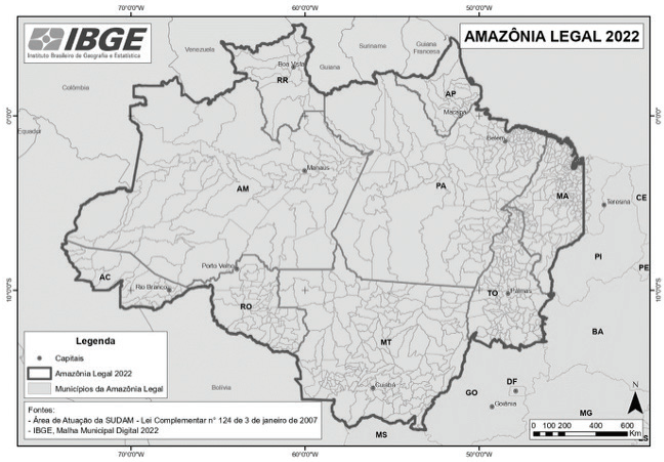
Source: Instituto Brasileiro de Geografia e Estatística (IBGE, 2022). Original version in Portuguese.
Belém is treated as a unique case in this research due to its historical role as the “Gateway to the Amazon” (De Jesús, 2013), marked by its strategic location, infrastructure, and importance as both an economic and cultural center. The city has held the title of UNESCO Creative City of Gastronomy since 2015 (UNESCO, 2025) and will host COP30, the United Nations Climate Change Conference (UNFCCC, 2025), underscoring its centrality in sustainability debates and Amazonian conservation efforts.
The field site for this study is the Ilha do Combu Environmental Protection Area, the fourth largest island in the municipality of Belém, covering 15.97 km². Situated along the Guamá River, it belongs to the Outeiro Administrative District, a subunit of Belém’s municipal government. The island is home to approximately 2,500 residents, distributed across four communities: Igarapé do Combu, Igarapé do Periquitaquara, Furo São Benedito, and Beira-Rio. According to the Instituto de Desenvolvimento Florestal e da Biodiversidade (IDEFLOR-BIO, 2018), many inhabitants continue to depend on fishing and extracting forest products such as fruits and medicinal plants.
Ilha do Combu was officially designated an Environmental Protection Area in 1997 under State Law No. 6.083, aligned with the provisions of Federal Law No. 9.985/2000, which established Brazil’s National System of Conservation Units (SNUC, in Portuguese) obey the Secretary of Environment and Sustainability of the State of Pará - Secretaria de Meio Ambiente e Sustentabilidade do Pará (SEMAS, 2021). While the area is managed at the state level and has an established management council, it still lacks an approved management plan, according to the Brazilian Ministry of the Environment (Ministério do Meio Ambiente e Mudança do Clima, MMA, 2022). Today, the island is also a prominent regional tourist destination, hosting over 50 restaurants and a chocolate factory within the Amazonian floodplain forest.
Two organizations were selected for this study based on the following criteria: (i) active in the creative economy, specifically in the field of gastronomy; (ii) involved in experiential tourism; (iii) incorporating sustainability dimensions into their strategic practices; (iv) operating continuously for at least five years; and (v) maintaining legal and fiscal compliance. Based on these parameters, the food businesses, such as Saldosa Maloca restaurant and the Filha do Combu Chocolate Factory, were chosen for analysis.
Saldosa Maloca is the island’s longest-running establishment, with continuous operations spanning 43 years. Chef and tourism specialist Prazeres Quaresma currently leads it. As a family-owned business passed down through generations, its management is composed entirely of island residents, which reinforces a locally grounded commitment to sustainability in business operations and in the stewardship of the protected area.
The Filha do Combu Chocolate Factory commenced informal operations in 2006 and was officially registered as a business in 2013. Today, it is the island’s most visited tourist destination. Its founder, Izete Costa, widely known as Dona Nena, was born on the island into a family of rural producers and developed expertise in cacao cultivation and traditional chocolate-making. She now oversees a vertically integrated production process, from harvesting cacao to producing fine chocolate in the heart of the Amazon Forest.
From an ethical standpoint, both entrepreneurs consented to participate in the research by signing informed consent forms and provided access to documents, including promotional materials published on websites and social media, internal records related to the planning of tourism product offerings, and communication materials (e.g., brochures) that described experiential itineraries.
Following this, exploratory research was conducted to identify the sustainability strategies employed by the two organizations between 2022 and 2024. Two concurrent methods of data collection were used. First, the research team carried out on-site observations; two team members had previously been embedded in the community, which facilitated access and local engagement. Second, an interview protocol was developed to guide the empirical application of the proposed framework. In early 2022, the entrepreneurs and managers of both organizations were interviewed in person. The interviews were recorded, transcribed, and archived in an online research repository.
Data from these interviews, along with organizational documents and periodic follow-up observations, were triangulated with the framework’s propositions. This process enabled the identification of 11 sustainability strategies shared by both organizations through thematic content analysis (Bardin, 2020). These strategies are listed in alphabetical order in Table 4.
Table 4
Identified sustainability strategies
The identified strategies emerged from a theoretical synthesis of the organizational resources and capabilities developed by the two businesses and made available to consumers. These strategies reflect, to differing extents, the three dimensions of sustainability, as evidenced by the empirical data collected and analyzed. The results contribute directly to addressing the research question outlined in the introduction and are further explored in the next section.
4. Evidence of sustainability strategies in the Brazilian Amazon
One of the core strategies for advancing sustainability is promoting tourism practices that value the ancestral knowledge of local and Indigenous populations. Biocultural tourism, a model aligned with this principle, has been widely examined in academic literature from Mexico and North America. It places particular emphasis on nature-based tourism in rural areas inhabited by Indigenous communities. From a biocultural perspective, this form of tourism can foster meaningful connections between environmental conservation and cultural preservation (Luque-Agraz, 2022).
Biocultural tourism is an alternative form of tourism that centers on the development of leisure, recreation, entertainment, and educational experiences, all of which are based on the conservation of natural resources, cultural heritage, and sustainable productive activities. It serves as an alternative pathway to promote the well-being of ancestral communities (Jasso Ariaga, 2018). Biocultural tourism constitutes a healthy, equitable, and inclusive recreational activity that sustainably manages the interaction between nature, culture and both productive and recreational practices (Arellano, Vidal y Aulet, 2024).
This research explores the potential for developing biocultural tourism (BT) in the Amazonian context. While rooted in nature-based tourism, the biocultural approach goes beyond ecological appreciation by emphasizing cultural memory and historical modes of human-nature interaction. It highlights the diverse and respectful relationships that human societies have established with the environment over time (Luque-Agraz, 2022).
BT is conceived as a planned, inclusive, and community-led practice that seeks to prevent the exploitation of biocultural heritage while promoting its preservation through principles of solidarity and reciprocity. It fosters a way of life that stands in contrast to capitalist models, prioritizing more equitable and culturally sensitive approaches to worldviews, belief systems, and practices that are often marginalized or at risk of disappearing (Bello y Pérez, 2017).
BT facilitates intercultural exchange among communities, grounded in their identities and traditional knowledge. It also celebrates local expressions of festivity and creativity, conveyed through arts, cuisine, music and dance. These cultural forms are closely tied to the vitality of the ecological systems in which they are embedded, reflecting the interconnectedness of human and non-human life within the biosphere (Luque-Agraz, 2022).
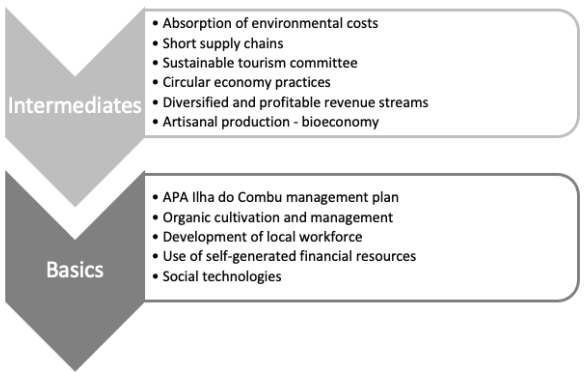
Considering each of the seven dimensions of sustainability presented in the framework by Negrão et al. (2024), a content analysis of the interviews led to the elaboration of a list of eleven strategies. These were categorized into two levels (Figure 3): foundational (basic) strategies and intermediate strategies.
4.1 Basics strategies
Basic strategies are defined as those that help the territory become minimally structured to develop sustainability practices.
4.1.1 Management Plan for the APA Ilha do Combu
These strategies relate primarily to legal, political and institutional aspects, as well as the norms that guide relationships and coexistence within a sustainable territory. Since 1997, Ilha do Combu has been designated as an Environmental Protection Area (Área de Proteção Ambiental - APA). However, nearly three decades later, it still lacks an approved management plan. Since the announcement that Belém will host the United Nations Climate Change Conference (COP30) in November 2025, efforts to finalize the area’s management plan have intensified.
In March 2025, Izete Costa, one of the interviewees and director of Filha do Combu Chocolates, participated in a working group tasked with drafting the final version of the plan. Discussions focused on strategic issues such as: who is allowed to reside on the island; who may own businesses; what types of enterprises may operate there; the island’s carrying capacity; regulations on lodging activities; the scope of permissible tourist activities; transportation within the island; and rules regarding motorized vehicles in areas inhabited by traditional communities.
Discussion of these issues and the involvement of local actors in decision-making are essential prerequisites. Hence, this is considered a basic strategy. Without such foundational rules, it is impossible to define roles or address institutional concerns.
4.1.2 Organic management and cultivation
The second set of strategies focuses on agricultural practices and food production within the territory, emphasizes environmental stewardship, particularly regarding the soil, rivers, air, fauna and flora.
Both Filha do Combu and the Eco Restaurante Saldosa Maloca maintain organic cultivation practices for fruits, medicinal herbs, and vegetables. At the chocolate factory, cacao seeds are transformed into fine cacao beans in a processing unit using fruits from the owners’ properties and other local suppliers.
Interviewees emphasized the importance of sustainable land use, cultivating only native cacao trees and propagating new plants using seeds collected on the island. Monocultures are avoided, and the cacao trees are interspersed with numerous other plant species to respect local biodiversity.
Their production includes a variety of fruits and herbs such as taperebá, açaí, mango, lemon balm, lemongrass, jenipapo, mint, basil, araçá, and pupunha, which are used to prepare juices, jams, liqueurs, creams, purées and cocktails. They also work with ingredients like andiroba seeds, ucuuba seeds, açaí pits, pupunha trunks, jupati seeds, cipó tracuá, priprioca roots, vindicá leaves, cinnamon, and basil, which are used to produce traditional medicines, repellents, colognes, bio-jewelry, decorative items, sachets and packaging.
4.1.3 Development of the local workforce
The third set of strategies focuses on human resources, specifically the development of knowledge, skills and psychological traits essential for local workers to participate in service delivery and the value-added processing of local raw materials.
At Restaurante Saldosa Maloca, there is a significant focus on the intellectual development of waiters, bartenders and cooks. Many arrive without formal education or prior cultural exposure to the norms of national or international tourism.
Few staff have dined at restaurants in Belém, and their upbringing in rural settings influences their preferences for open-air leisure and social spaces. This limits their familiarity with the formalities of customer service. However, the owner, Prazeres, reported notable improvements in their environmental awareness, interpersonal communication, and overall professionalism.
Despite having limited formal education, the local workforce, largely composed of traditional riverine residents, contributes distinct cultural and ecological knowledge shaped by their lived experiences. Their familiarity with local ingredients and culinary practices enables them to engage visitors meaningfully, offering detailed explanations of menus and strengthening the connection between gastronomy and place.
At the chocolate factory, Dona Nena described the challenges of training women in fine chocolate production, emphasizing the need for precision in processes such as fermentation, drying, roasting, and refining. These tasks require knowledge in mathematics, physics, and chemistry, yet also rely on ancestral knowledge and embody practices that formal education cannot replicate.
Thus, addressing workforce development is critical for ensuring that these enterprises can be recognized for their sustainability practices. Bridging knowledge and opportunity gaps must be part of a locally grounded solution.
4.1.4 Self-financing strategies
The fourth group of strategies focuses on implementing financial management routines to maintain stable cash flow and build working capital. Local creative entrepreneurs leverage their knowledge of natural and cultural resources, which are central to territorial identity, to incorporate locally sourced raw materials into their business models. This approach supports both economic self-sufficiency and cultural continuity.
The interviewed entrepreneurs’ deep knowledge of the island’s biodiversity helps them select ingredients for their product portfolios. Fruits, herbs, oils, spices and seeds are used in both chocolate and culinary products. These enterprises offer biocultural tourism experiences that showcase ingredient preparation and highlight the cultural traditions and mysticism of the Amazon.
4.1.5 Social technologies
The fifth set of basic strategies involves fundamental infrastructure for water, energy, and sewage treatment.
At Filha do Combu, all restrooms, both in Izete Costa’s residence and those available to customers, are connected to evapotranspiration tanks (TEVAPs). These systems filter wastewater through multiple layers of materials and vegetation to prevent soil contamination.
The layers include tires and construction debris, gravel, coarse and fine sand, and fertile soil planted with banana and taioba plants for their high absorption and transpiration capacities. These systems have been implemented at Prazeres Quaresma’s residence, and a similar installation at her restaurant is underway.
The enterprises funded these investments entirely, with guidance from Professor Vânia Neu of the Federal Rural University of the Amazon (UFRA). The technology is transferred to local builders and maintenance staff.
Another initiative is the rainwater harvesting system, supported by UFRA and the Rotary Club of Belém Noroeste. Filha do Combu has invested in gutters, tanks, and filters (e.g., sodium hypochlorite treatment and activated carbon) to improve water quality. The water supplies the kitchens and coffee shop, providing better quality (pH 7.7 compared to bottled water’s pH 4.3).
Restaurante Saldosa Maloca’s biodigesters process organic waste (i.e., food scraps and plate leftovers) into biofertilizer and cooking gas. This system reduces the use of liquefied petroleum gas (LPG) and supports more sustainable kitchen operations.
4.2 Intermediates strategies
Figure 4 illustrates the relationship between the intermediate sustainability strategies identified in the research and the dimensions of sustainability, showing that the developed strategies exhibit a weak relationship with the social dimension. In contrast, the information and knowledge dimension show a strong relationship with most of the intermediate strategies.
Figure 4
Relationship between intermediate sustainability strategies and the dimensions of sustainability

Note. Legend (--) Weak relationship; (o) Intermediate relationship; (O) Strong relationship.
Source: Research data.
In the case of the environmental dimension, there is a strong relationship with absorption strategies, environmental costs, and circular economy practices. Regarding the geographic and spatial dimensions, most intermediate strategies exhibit a strong correlation. These results reveal the heterogeneity present in the development of intermediate strategies across the dimensions, indicating the need to promote practices that foster social and sustainable inclusion within the analyzed enterprises.
4.2.1 Artisanal production - Bioeconomy
In addition to advancing organic cultivation and sustainable forest management, the entrepreneurs illustrate how to add value to non-timber forest products through vertical integration. At Filha do Combu Chocolates, cacao is the primary fruit used. Its pulp is transformed into jam and liqueur, while the beans are processed into a range of products, including cacao mass, powder, nibs, chocolate liqueur, cakes, bread, brigadeiros, bonbons and premium chocolate bars.
To experience this complete “forest-to-bar” production cycle, visitors can purchase tickets to participate in experiences combining historical and cultural perspectives on Amazonian cacao cultivation with demonstrations of key stages in chocolate manufacturing. Ancestral recipes are highlighted, including cacao eggnog, which served as an energy booster for rubber tappers in the late 19th and early 20th centuries.
Dona Nena also integrates cupuaçu into her production line through sweets, juices, liqueurs and bonbons. Pupunha is sold raw, cooked, as tapioca filling, and even as a base for hot dishes. Açaí is transformed into jam and sold freeze-dried. Other fruits such as araçá, jenipapo and taperebá are prominent in Filha do Combu’s product line.
At Restaurante Saldosa Maloca, the açaí supply chain is a highlight, showcased through the restaurant’s menu and the “Açaí Tuíra” experience, which presents the fruit’s legends, culinary uses, and economic significance in Pará. Prazeres Quaresma also reports producing liqueurs, juices, ice creams and jams from jenipapo, lemongrass, mango, taperebá, araçá, açaí, and cupuaçu.
4.2.2 Absorption of environmental costs
As part of their broader commitment to sustainable business practices, the interviewees expressed their concern about minimizing the environmental impact of tourism expansion in the APA Combu. This concern has become more pronounced since the introduction of electricity in 2010 and the subsequent increase in restaurant activity, which began in 2018.
Dona Nena and Prazeres described their efforts to control erosion along river and stream banks and emphasized the importance of understanding the region’s biodiversity. They have initiated projects to replant aninga along the banks and to expand the cultivation of palm trees that provide fruit for local rodents.
Another key initiative is the beekeeping of stingless native bees, especially the yellow uruçu, which contributes to the pollination of various fruit trees, including buriti, ouricuri, and açaí palms, as well as ingá and annatto trees.
Both entrepreneurs have deliberately chosen not to install chlorinated swimming pools, citing concerns about their environmental impact and the type of tourism they believe attract, which they consider misaligned with the area’s ecological and cultural context. They also implement a range of sustainable practices, including the preservation of native cacao varieties, the rejection of clonal and genetically modified seedlings, and adherence to natural harvest seasons and ecological cycles.
4.2.3 Circular economy practices
A concerted effort has been made to optimize the use of natural and material resources in tourism development in APA Combu. This includes cultivating pesticide-free gardens and composting waste to enrich the soil.
At Saldosa Maloca, biodigesters reduce organic waste sent to Belém’s landfill. These digesters process food scraps into biofertilizers and biogas, fueling some kitchen stovesing and reducing reliance on liquefied petroleum gas (LPG).
The TEVAP systems also recycle water and provide nutrient sources for plant growth. Both businesses practice sustainable consumption by minimizing waste, harvesting rainwater, and implementing waste sorting systems.
4.2.4 Short supply chains
Short supply chains reduce the number of intermediaries between producers and end consumers, increasing efficiency and sustainability. In the context of Ilha do Combu, this is exemplified by chocolate production at Filha do Combu, where fruits are either grown on-site or purchased directly from local farmers. All stages of production - from bean to bar - occur on the island.
Products are then sold directly at the factory shop, creating a near-direct connection between producer and consumer. This model also applies to other processed fruits used in liqueurs, jams and sweets. At Restaurante Saldosa Maloca, short supply chains are used in the processing of açaí, cassava, taperebá, mango and cupuaçu.
Short supply chains enable family farmers and cooperatives to sell directly to local markets, thereby reducing their dependency on intermediaries who retain most of the added value. This enhances producer income, strengthens the local economy, and reduces logistical costs and carbon emissions, thereby contributing to climate change mitigation.
Thus, short supply chains are a viable and efficient strategy for advancing the potential of the Amazonian bioeconomy while promoting social equity, environmental conservation and regional economic development.
4.2.5 Diversified and profitable revenue streams
The pursuit of diversified and profitable revenue streams in the Amazonian Bioeconomy must be guided by sustainability, innovation and the valorization of local resources. Responsible use of biodiversity is foundational to creating economic value, and diversification is essential for economic resilience and environmental conservation.
When products are sold solely as commodities, profit margins tend to remain low. However, by adding value locally through freshness, product differentiation and immersive experiences, entrepreneurs can increase prices, improve operational efficiency, and foster innovation in revenue models. These strategies often combine internal resources with complementary assets from the Combu Island business ecosystem, including agroforestry, biocultural tourism and partnerships with scientific research initiatives.
Strategic partnerships with national and international companies can expand market access and support technology development and certification efforts, thereby enhancing product competitiveness. Local capacity-building and entrepreneurship support are the role of producers in the value chain.
4.2.6 Sustainable tourism committee
Established in December 2024, the Sustainable Tourism Committee fosters sustainable and integrated tourism development in Ilha do Combu. This committee promotes cooperation among residents and business owners to address local challenges related to sanitation, potable water, waste management, transportation, health, safety, capacity building and business performance.
The Committee’s mission extends beyond tourism: it aims to safeguard the well-being and rights of all residents of Ilha do Combu, ensuring that the benefits of tourism are distributed fairly and equitably among the local population.
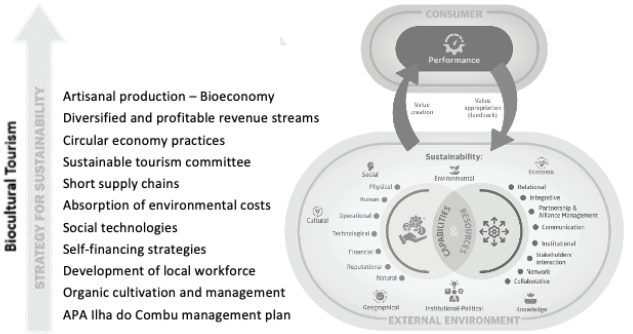
By the way, the strategies captured, described and proposed from the field research were articulated with the framework of Negrão et al. (2024) as a way of understanding biocultural tourism, a practiced form of creative economy based on natural resources, which was called in this article creative bioeconomy (Figure 5) considering the reality of the Brazilian Amazon studied, in this case, Combu Island, in the city of Belém, Pará, Brazil.
4.3 Discussions and implications
From a practical and managerial perspective, the basic and intermediate strategies combine resources manifested in capabilities that integrate internal and external elements to support organizational decision-making processes.
4.3.1 Integrative capability
Developing the local workforce by building capabilities in sensing, seizing and transforming allows companies to identify and capitalize on new opportunities, thereby enhancing both operational and financial performance (Vanpoucke et al., 2014). This process also enables firms to convert operational competencies into a sustainable competitive advantage (Jiang et al., 2015).
Strategies such as organic management and cultivation, artisanal production, bioeconomy, circular economy practices, and absorption of environmental costs combine natural, physical, technical, climatic, cultural, and knowledge-based resources to facilitate a proactive environmental strategy (Li et al., 2017) that economically benefits both the organization and its partners (Hartmann and Germain, 2015).
These resource combinations have also laid the foundation for developing the Management Plan for APA Ilha do Combu, which is an initiative closely linked to the capacity to build partnerships and manage alliances. In this context, stakeholders contribute their specific competencies, adding value to the partnership (Lemmetyinen and Go, 2009).
4.3.2 Collaborative capability
The strategy of utilizing self-generated financial resources is enhanced by a networking capability, which enables firms to access partner resources, engage in collaboration, and create value (Ryan, 2012). When combined with dynamic resources, collaborative capability can generate economic value for the network and facilitate mutual success (Hofmann et al., 2012).
Social technologies, connected to technological resources, are also closely tied to collaborative capability. Organizations can share knowledge and address structural challenges (Van Hoof and Thiell, 2014), use resources strategically, innovate (Dangelico et al., 2013), and promote information exchange among stakeholders (Hidayah, 2016)
4.3.3 Relational capacity
The short supply chain strategy aims to foster local relationships by minimizing intermediaries between producers and end consumers. These relationships are cultivated in the daily operations of firms and generate long-term benefits, helping to establish sustainable competitive advantages (Rodríguez Díaz and Espino Rodríguez, 2008).
The strategy of diversified and profitable revenue streams requires technical knowledge in innovation, cost management, and pricing. It also involves building and strengthening contact networks that support the co-creation of value (Mu, 2013) and foster long-term collaborative relationships (Paulraj, 2011).
The establishment of the Sustainable Tourism Committee also enhances relational capability by fostering strong stakeholder interaction, generating new knowledge, improving management capacity, encouraging mutual learning, and producing collective benefits (Veldhuizen et al., 2013; Spekkink, 2015; Worley et al., 2010).
In sum, each strategy, whether basic or intermediate, can be associated with multiple resources and capabilities, reflecting the integrative context required by sustainability, biocultural tourism and the creative economy. Based on the Sustainability Strategies Framework (Negrão et al., 2024) and the results of its application to the enterprises studied, this research prompts reflection: Is it possible to advance the Resource-Based View (RBV) beyond the natural elements proposed by the Natural Resource-Based View (NRBV)? How can we strengthen the sustainability debate by expanding its dimensions to better address the complexity of territorial dynamics?
Figure 6 shows that the set of basic strategies has an intermediate to strong relationship with the geographic or spatial dimension. Similarly, the environmental dimension is strongly related to strategies involving APA planning, organic culture, and social technologies. The strategies within the cultural dimension are weakly or moderately related to those classified as basic strategies.
Figure 6
Relationship between basic sustainability strategies and the dimensions of sustainability
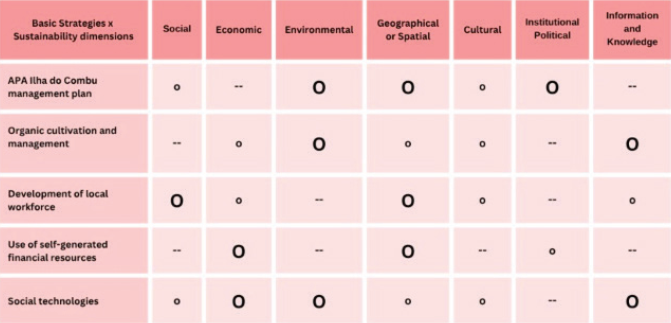
Note. Legend (--) Weak relationship; (o) Intermediate relationship; (O) Strong relationship.
Research data.
These relationships demonstrate that both basic and intermediate strategies exhibit weak to moderate relationships with the social and cultural dimensions, underscoring the need to refine these strategies to facilitate the development of a people-centered society and promote equity in wealth and income distribution, thereby enhancing rights and living conditions. To achieve this, it is necessary to create jobs that ensure income, invest in the community, uphold human rights, and promote public safety.
Advancing sustainability in this context requires incorporating local cultural elements, integrating scientific and traditional knowledge, fostering local governance mechanisms, and addressing socioeconomic inequalities, all while maintaining a strong commitment to environmental preservation. As the creative sector expands in the region, these dimensions become increasingly vital.
An analysis of the strategies adopted by enterprises in Belém, the capital of Pará in the Brazilian Amazon, underscores the limitations of the traditional Triple Bottom Line (TBL) framework, as proposed by Elkington (1997, 2018). Advancing sustainability in this context requires incorporating local cultural elements, integrating scientific and traditional knowledge, fostering local governance mechanisms, and addressing socioeconomic inequalities, all while maintaining a strong commitment to environmental preservation. As the creative industry expands in the region, these dimensions become increasingly vital.
Based on the evidence presented in this study, we propose the term Creative Bioeconomy and suggest a progression toward a Sustainable Resource-Based View (SRBV).
5. Final considerations
This study’s theoretical contribution lies in the practical application of NRBV concepts in enterprises that incorporate environmental strategies. It also demonstrates that this theoretical approach can be applied to small service-sector businesses, which are often overlooked in RBV and NRBV studies focusing on large industrial firms. The methodological procedures used here are replicable for other businesses operating in APAs.
The research ,provides strategic insights for the enterprises studied, which can guide investment decisions toward more rapid and prosperous outcomes while enhancing visitor experiences. These findings may also serve as models for other enterprises on the island. For clients and society, the study confirms potential for harmonious relationships among businesses, clients, communities, and the environment.
The research shows that food businesses in Ilha do Combu are developing distinctive strategies within the tourism sector, particularly gastronomic tourism. Their approach extends beyond food consumption, enabling visitors to understand and experience the entire food production process and its cultural and environmental contexts.
However, the study also finds that, despite strategic advances, not all sustainability-related supply chains have been explored to their full potential. Doing so could further enhance tourism on the island and deliver greater benefits to the businesses and stakeholders involved.
From a theoretical standpoint, based on the Sustainability Strategies Framework (Negrão et al., 2024) and its application to the studied enterprises, the authors propose evolving from the RBV and NRBV toward a Sustainable Resource-Based View (SRBV). The traditional economic, social, and environmental dimensions are insufficient to explain all the dynamics within the context of the Creative Bioeconomy.
Additionally, the study’s focus on sustainability strategies limited a more detailed examination of the specific organizational resources and capabilities that shape these strategies and influence how value is created and appropriated by consumers and other stakeholders. Nonetheless, future research could address these dimensions by including additional organizations, conducting comparative studies, or exploring other regions relevant to the bioeconomy.
The proposed framework has demonstrated flexibility and adaptability across organizational contexts engaged in sustainability initiatives. It accommodates the inclusion and adaptation of new attributes, offering a useful model for analyzing the interplay among resources, capabilities, sustainability, and value creation and appropriation.
Acknowledgments
To the Brazilian National Counsel of Technological and Scientific Development (CNPq), the Minas Gerais State Research Foundation (FAPEMIG) and the Coordination for the Improvement of Higher Education Personnel (CAPES), Ministry of Education, Brazil - Finance Code 001. Additional thanks to the anonymous reviewers and editorial staff of the Journal of Economics - Revista de Economía, Facultad de Economía, Universidad Autónoma de Yucatán for their valuable contributions to the improvement of this article.
References
Albino, V., L. Fraccascia, and I. Giannoccaro. 2016. “Exploring the Role of Contracts to Support the Emergence of Self-Organized Industrial Symbiosis Networks: An Agent-Based Simulation Study”, Journal of Cleaner Production, 112: 4353-4366. https://doi.org/10.1016/j.jclepro.2015.06.070
V. Albino L. Fraccascia I. Giannoccaro 2016Exploring the Role of Contracts to Support the Emergence of Self-Organized Industrial Symbiosis Networks: An Agent-Based Simulation StudyJournal of Cleaner Production1124353436610.1016/j.jclepro.2015.06.070
Amit, R. and P. J. H. Schoemaker. 1993. “Strategic assets and organizational rent”, Strategic Management Journal, 14 (1): 33-46. https://doi.org/10.1002/smj.4250140105
R. Amit P. J. H. Schoemaker 1993Strategic assets and organizational rentStrategic Management Journal141334610.1002/smj.4250140105
Arellano, S. L., D. Vidal and S. Aulet. 2024. “Etno conocimientos y turismo biocultural en el Imbabura Geoparque Mundial UNESCO”, Cuadernos gestión turística del patrimonio, 3 (1): 125-159. https://cuadernosgestionturisticadelpatrimonio.es/index.php/journal/article/view/32
S. L. Arellano D. Vidal S. Aulet 2024Etno conocimientos y turismo biocultural en el Imbabura Geoparque Mundial UNESCOCuadernos gestión turística del patrimonio31125159https://cuadernosgestionturisticadelpatrimonio.es/index.php/journal/article/view/32
Bansal, P. 2002. “The corporate challenges of sustainable development”, Academy of Management Perspectives, 16 (2): 122-131. https://doi.org/10.5465/ame.2002.7173572
P. Bansal 2002The corporate challenges of sustainable developmentAcademy of Management Perspectives16212213110.5465/ame.2002.7173572
Barney, J. B. 1991. “Firm resources and sustained competitive advantage”, Journal of Management, 17 (1): 99-120. https://doi.org/10.1177/014920639101700108
J. B. Barney 1991Firm resources and sustained competitive advantageJournal of Management1719912010.1177/014920639101700108
Barney, J. B. , D. J. Ketchen Jr and M. Wright. 2021. “Resource-based theory and the value creation framework”, Journal of Management, 47(7), 1936-1955. https://doi.org/10.1177/01492063211021655
J. B. Barney D. J. Ketchen Jr M. Wright 2021Resource-based theory and the value creation frameworkJournal of Management4771936195510.1177/01492063211021655
Bello, I. and A. M. Pérez. 2017. “Turismo biocultural: relación entre el patrimonio biocultural y el fenómeno turístico. experiencias investigativas?”, Scripta ethnologica, 39: 109-128. https://www.redalyc.org/pdf/148/14853734005.pdf
I. Bello A. M. Pérez 2017Turismo biocultural: relación entre el patrimonio biocultural y el fenómeno turístico. experiencias investigativas?Scripta ethnologica39109128https://www.redalyc.org/pdf/148/14853734005.pdf
Bowman, C. and V. Ambrosini. 2000. “Value Creation Versus Value Capture: Towards a Coherent Definition of Value in Strategy”, British Journal of Management, 11 (1): 1-15. https://doi.org/10.1111/1467-8551.00147
C. Bowman V. Ambrosini 2000Value Creation Versus Value Capture: Towards a Coherent Definition of Value in StrategyBritish Journal of Management11111510.1111/1467-8551.00147
Brito, R. P. and L. A. L. Brito. 2012. “Vantagem competitiva e sua relação com o desempenho: Uma abordagem baseada em valor”, Revista de Administração Contemporânea, 16 (3): 360-380. https://doi.org/10.1590/S1415-65552012000300003
R. P. Brito L. A. L. Brito 2012Vantagem competitiva e sua relação com o desempenho: Uma abordagem baseada em valorRevista de Administração Contemporânea16336038010.1590/S1415-65552012000300003
Caldeira, T. P. R. 2016. “Peripheral urbanization: Autoconstruction, transversal logics, and politics in cities of the global south”, Environment and Planning D, 35 (1): 3-20. https://doi.org/10.1177/0263775816658479
T. P. R. Caldeira 2016Peripheral urbanization: Autoconstruction, transversal logics, and politics in cities of the global southEnvironment and Planning D35132010.1177/0263775816658479
Castro, V. A. 2016. Obtenção de vantagem competitiva sustentável na perspectiva Resource-based view: A construção de marcas compartilhadas como recurso interno no setor vitivinicultor brasileiro. PhD diss., Universidade de São Paulo, São Paulo. https://doi.org/10.11606/T.96.2016.tde-29112016-115831
V. A. Castro 2016Obtenção de vantagem competitiva sustentável na perspectiva Resource-based view: A construção de marcas compartilhadas como recurso interno no setor vitivinicultor brasileiroPhD dissUniversidade de São PauloSão Paulo10.11606/T.96.2016.tde-29112016-115831
Capaldo, A. 2007. “Network structure and innovation: The leveraging of a dual network as a distinctive relational capability”, Strategic Management Journal, 28 (6): 585-608. https://doi.org/10.1002/smj.621
A. Capaldo 2007Network structure and innovation: The leveraging of a dual network as a distinctive relational capabilityStrategic Management Journal28658560810.1002/smj.621
Choi, D. and T. Hwang. 2015. “The impact of green supply chain management practices on firm performance: The role of collaborative capability”, Operations Management Research, 8 (3) : 69-83. https://doi.org/10.1007/s12063-015-0100-x
D. Choi T. Hwang 2015The impact of green supply chain management practices on firm performance: The role of collaborative capabilityOperations Management Research83698310.1007/s12063-015-0100-x
Costanza, R., R. Groot, P. Sutton, S. Van Der Ploeg, S. J. Anderson, I. Kubiszewski, and R. K. Turner. 2014. “Changes in the global value of ecosystem services”, Global Environmental Change, 26: 152-158. https://doi.org/10.1016/j.gloenvcha.2014.04.002
R. Costanza R. Groot P. Sutton S. Van Der Ploeg S. J. Anderson I. Kubiszewski R. K. Turner 2014Changes in the global value of ecosystem servicesGlobal Environmental Change2615215810.1016/j.gloenvcha.2014.04.002
Dalmago, G. A. 2021. “Sustentabilidade: reflexões sobre uso do termo e evolução de conceitos.” Embrapa Trigo-Documentos (INFOTECA-E). https://www.infoteca.cnptia.embrapa.br/infoteca/handle/doc/1131564
G. A. Dalmago 2021Sustentabilidade: reflexões sobre uso do termo e evolução de conceitosEmbrapa Trigo-Documentos (INFOTECA-E)https://www.infoteca.cnptia.embrapa.br/infoteca/handle/doc/1131564
Dangelico, R. and B. Pontrandolfo. 2013. “‘Green and Competitive’: The impact of environmental actions and collaborations on firm performance”, Business Strategy and The Environment, 24 (6), 413-430. https://doi.org/10.1002/bse.1828
R. Dangelico B. Pontrandolfo 2013‘Green and Competitive’: The impact of environmental actions and collaborations on firm performanceBusiness Strategy and The Environment24641343010.1002/bse.1828
Dierickx, I., and K. Cool. 1989. “Asset Stock Accumulation and Sustainability of Competitive Advantage”, Management Science, 35: 1504-1511. https://doi.org/10.1287/mnsc.35.12.1504
I. Dierickx K. Cool 1989Asset Stock Accumulation and Sustainability of Competitive AdvantageManagement Science351504151110.1287/mnsc.35.12.1504
Dyllick, T. and K. Hockerts. 2002. “Beyond the business case for corporate sustainability”, Business strategy and the environment, 11 (2): 130-141. https://doi.org/10.1002/bse.323
T. Dyllick K. Hockerts 2002Beyond the business case for corporate sustainabilityBusiness strategy and the environment11213014110.1002/bse.323
Emmendoerfer, M. L., A. S. A. Fioravante and J. F. F. E. Araújo. 2018. “Federal government actions for the creative territories development in brazilian context”, Revista Brasileira de Gestão e Desenvolvimento Regional, 14 (1): 400-424. https://www.rbgdr.net/revista/index.php/rbgdr/article/view/3497
M. L. Emmendoerfer A. S. A. Fioravante J. F. F. E. Araújo 2018Federal government actions for the creative territories development in brazilian contextRevista Brasileira de Gestão e Desenvolvimento Regional141400424https://www.rbgdr.net/revista/index.php/rbgdr/article/view/3497
European Commission. 2012. Innovating for Sustainable Growth: A Bioeconomy for Europe. European Commission, Brussels, in https://op.europa.eu/en/publication-detail/-/publication/1f0d8515-8dc0-4435-ba53-9570e47dbd51
European Commission 2012Innovating for Sustainable Growth: A Bioeconomy for EuropeEuropean CommissionBrusselshttps://op.europa.eu/en/publication-detail/-/publication/1f0d8515-8dc0-4435-ba53-9570e47dbd51
Ferrer, G. R. and P. M. Cruz. 2017. “Direito, sustentabilidade e a premissa tecnológica como ampliação de seus fundamentos”, en M. C. S. A. Souza and E. N. Rezende (eds.), Sustentabilidade e meio ambiente: efetividades e desafios, Editora D’Plácido, Belo Horizonte.
G. R. Ferrer P. M. Cruz 2017Direito, sustentabilidade e a premissa tecnológica como ampliação de seus fundamentos M. C. S. A. Souza E. N. Rezende Sustentabilidade e meio ambiente: efetividades e desafiosEditora D’PlácidoBelo Horizonte
Garcia, H. S. and D. S. S. Garcia. 2016. “A Construção de um Conceito de Sustentabilidade Solidária Contribuições Teóricas para o Alcance do Socioambientalismo”, Revista de Direito Ambiental e Socioambientalismo, 2 (2): 147-168. https://doi.org/10.26668/IndexLawJournals/2525-9628/2016.v2i2.1620
H. S. Garcia D. S. S. Garcia 2016A Construção de um Conceito de Sustentabilidade Solidária Contribuições Teóricas para o Alcance do SocioambientalismoRevista de Direito Ambiental e Socioambientalismo2214716810.26668/IndexLawJournals/2525-9628/2016.v2i2.1620
Grant, R. M. 1991. “The Resource-Based Theory of Competitive Advantage: Implications of Strategic Formulation”, California Management Review, 33 (3): 114-134. https://doi.org/10.2307/41166664
R. M. Grant 1991The Resource-Based Theory of Competitive Advantage: Implications of Strategic FormulationCalifornia Management Review33311413410.2307/41166664
Gray, K. and B. K. Gills. 2016. “South-South cooperation and the rise of the Global South”, Third World Quarterly, 37 (4): 557-574. https://doi.org/10.1080/01436597.2015.1128817
K. Gray B. K. Gills 2016South-South cooperation and the rise of the Global SouthThird World Quarterly37455757410.1080/01436597.2015.1128817
Hahn, T., F. Figge, J. Pinkse and L. Preuss. 2010. “Trade-offs in corporate sustainability: You can’t have your cake and eat it”, Business strategy and the environment, 19 (4): 217-229. https:// doi.org/10.1002/bse.674
T. Hahn F. Figge J. Pinkse L. Preuss 2010Trade-offs in corporate sustainability: You can’t have your cake and eat itBusiness strategy and the environment19421722910.1002/bse.674
Hart, S. L. 1995. “A Natural-Resource-Based View of the Firm”, Academy of Management Review, 20 (4): 986-1014. https://doi.org/10.5465/amr.1995.9512280033
S. L. Hart 1995A Natural-Resource-Based View of the FirmAcademy of Management Review204986101410.5465/amr.1995.9512280033
Hart, S. L. , and M.B. Milstein. 2004. “Criando valor sustentável”, GV-executivo, 3 (2): 65-79. https://doi.org/10.12660/gvexec.v3n2.2004.34820
S. L. Hart M.B. Milstein 2004Criando valor sustentávelGV-executivo32657910.12660/gvexec.v3n2.2004.34820
Hart, S. L. , and G. Dowell. 2011. “Invited Editorial: A Natural-Resource-Based View of the Firm: Fifteen Years After”, Journal of Management, 37 (5): 1464-1479. https://doi.org/10.1177/0149206310390219
S. L. Hart G. Dowell 2011Invited Editorial: A Natural-Resource-Based View of the Firm: Fifteen Years AfterJournal of Management3751464147910.1177/0149206310390219
Hartmann, J, and R. Germain. 2015. “Understanding the relationships of integration capabilities, ecological product design, and manufacturing performance”, Journal of Cleaner Production, 92: 196-205. https://doi.org/10.1016/j.jclepro.2014.12.079
J Hartmann R. Germain 2015Understanding the relationships of integration capabilities, ecological product design, and manufacturing performanceJournal of Cleaner Production9219620510.1016/j.jclepro.2014.12.079
Hickel, J., C. Dorninger, H. Wieland and I. Suwandi. 2022. “Imperialist appropriation in the world economy: drain from the global South through unequal exchange, 1990-2015”, Global Environmental Change, 73. http://doi.org/10.1016/j.gloenvcha.2022.102467
J. Hickel C. Dorninger H. Wieland I. Suwandi 2022Imperialist appropriation in the world economy: drain from the global South through unequal exchange, 1990-2015Global Environmental Change7310.1016/j.gloenvcha.2022.102467
Hidayah, Z. 2016. “Leadership Role and Social Green Relational Capabilities, Network and Symmetric Collaboration in Organization’s Performance”, International Journal of Applied Business and Economic Research, 14(1): 97-114.
Z. Hidayah 2016Leadership Role and Social Green Relational Capabilities, Network and Symmetric Collaboration in Organization’s PerformanceInternational Journal of Applied Business and Economic Research14197114
Hohn, G. S., S. D. Kruger, E. A. Santos and A. Zanin. 2023. “Recursos E Capacidades Organizacionais No âmbito Industrial Sob a Perspectiva Da visão Baseada Em Recursos”, Revista Gestão & Tecnologia, 23(2): 294-317. https://doi.org/10.20397/2177-6652/2023.v23i2.2497
G. S. Hohn S. D. Kruger E. A. Santos A. Zanin 2023Recursos E Capacidades Organizacionais No âmbito Industrial Sob a Perspectiva Da visão Baseada Em RecursosRevista Gestão & Tecnologia23229431710.20397/2177-6652/2023.v23i2.2497
Hofmann, K. H., G. Theyel and C. H. Wood. 2012. “Identifying Firm Capabilities as Drivers of Environmental Management and Sustainability Practices - Evidence from Small and Medium-Sized Manufacturers”, Business Strategy and the Environment, 21 (8): 530-545. https://doi.org/10.1002/bse.739
K. H. Hofmann G. Theyel C. H. Wood 2012Identifying Firm Capabilities as Drivers of Environmental Management and Sustainability Practices - Evidence from Small and Medium-Sized ManufacturersBusiness Strategy and the Environment21853054510.1002/bse.739
IDEFLOR-BIO. 2018. Área de Proteção Ambiental da Ilha do Combu, in https://ideflorbio.pa.gov.br/area-de-protecao-ambiental-da-ilha-do-combu-apa-da-ilha-do-combu/
IDEFLOR-BIO 2018Área de Proteção Ambiental da Ilha do Combuhttps://ideflorbio.pa.gov.br/area-de-protecao-ambiental-da-ilha-do-combu-apa-da-ilha-do-combu/
IBGE. 2022. Mapa da Amazônia Legal 2022, in https://geoftp.ibge.gov.br/organizacao_do_territorio/estrutura_territorial/amazonia_legal/2022/Mapa_da_Amazonia_Legal_2022_sem_sedes.pdf
IBGE 2022Mapa da Amazônia Legal 2022https://geoftp.ibge.gov.br/organizacao_do_territorio/estrutura_territorial/amazonia_legal/2022/Mapa_da_Amazonia_Legal_2022_sem_sedes.pdf
Ito, N. C., N. Iwazaki and L. A. Mariz. 2012. “Valor e vantagem competitiva: buscando definições, relações e repercussões”, Revista de Administração Contemporânea, 16: 290-307. https://doi.org/10.1590/S1415-65552012000200008
N. C. Ito N. Iwazaki L. A. Mariz 2012Valor e vantagem competitiva: buscando definições, relações e repercussõesRevista de Administração Contemporânea1629030710.1590/S1415-65552012000200008
Jasso Arriaga, X. 2018. “Análisis y perspectivas para gestionar el turismo biocultural: una opción para conservar el ecosistema forestal de Temascaltepec”, Madera y bosques, 24 (1), e2411451. https://doi.org/10.21829/myb.2018.2411451
X. Jasso Arriaga 2018Análisis y perspectivas para gestionar el turismo biocultural: una opción para conservar el ecosistema forestal de TemascaltepecMadera y bosques241e241145110.21829/myb.2018.2411451
Jiang, W., F. T. Mavondo and M. J. Matanda. 2015. “Integrative capability for successful partnering: a critical dynamic capability”, Management Decision, 53 (6): 1184-1202. https://doi.org/10.1108/MD-04-2014-0178
W. Jiang F. T. Mavondo 2015Integrative capability for successful partnering: a critical dynamic capabilityManagement Decision5361184120210.1108/MD-04-2014-0178
Lemmetyinen, A. and F. M. Go. 2009. “The key capabilities required for managing tourism business networks”, Tourism Management, 30 (1): 31-40. https://doi.org/10.1016/j.tourman.2008.04.005
A. Lemmetyinen F. M. Go 2009The key capabilities required for managing tourism business networksTourism Management301314010.1016/j.tourman.2008.04.005
Li, E. L., L. Zhou and A. Wu. 2017. “The supply-side of environmental sustainability and export performance: The role of knowledge integration and international buyer involvement”, International Business Review, 26 (4): 724-735. https://doi.org/10.1016/j.ibusrev.2017.01.002
E. L. Li L. Zhou A. Wu 2017The supply-side of environmental sustainability and export performance: The role of knowledge integration and international buyer involvementInternational Business Review26472473510.1016/j.ibusrev.2017.01.002
Luque-Agraz, D. 2022. “Turismo biocultural y la agenda global en la Era del Antropoceno. Estudios sociales”, Revista de alimentación contemporánea y desarrollo regional, 32 (59): 1-17. https://doi.org/10.24836/es.v32i59.1210
D. Luque-Agraz 2022Turismo biocultural y la agenda global en la Era del Antropoceno. Estudios socialesRevista de alimentación contemporánea y desarrollo regional325911710.24836/es.v32i59.1210
Luzzini, D., E. Brandon-Jones, A. Brandon-Jones and G. Spina. 2015. “From Sustainability Commitment to Performance: The Role of Intra- and Inter-Firm Collaborative Capabilities in the Upstream Supply Chain”, International Journal of Production Economics, 165: 51-63. https://doi.org/10.1016/j.ijpe.2015.03.004
D. Luzzini E. Brandon-Jones A. Brandon-Jones G. Spina 2015From Sustainability Commitment to Performance: The Role of Intra- and Inter-Firm Collaborative Capabilities in the Upstream Supply ChainInternational Journal of Production Economics165516310.1016/j.ijpe.2015.03.004
Negrão, K. R. M., S. C. Gomes, M. C. D. S. Carvalho and M. L. Emmendoerfer. 2024. “Strategic Management for Sustainability”, Revista de Administração Contemporânea, 28(06), e240221. https://doi.org/10.1590/1982-7849rac2024240221.en
K. R. M. Negrão S. C. Gomes M. C. D. S. Carvalho M. L. Emmendoerfer 2024Strategic Management for SustainabilityRevista de Administração Contemporânea2806e24022110.1590/1982-7849rac2024240221.en
Maldonado-Guzmán, G., A. Madrid-Guijarro, M. C. Martínez-Serna and L. Aguilera-Enríquez. 2009. “Los Efectos De La innovación En El Rendimiento De Las MIPYMES De Aguascalientes: Una Evidencia empírica”, Revista de Economía, 26 (73): 49-69. https://doi.org/10.33937/reveco.2009.8
G. Maldonado-Guzmán A. Madrid-Guijarro M. C. Martínez-Serna L. Aguilera-Enríquez 2009Los Efectos De La innovación En El Rendimiento De Las MIPYMES De Aguascalientes: Una Evidencia empíricaRevista de Economía2673496910.33937/reveco.2009.8
MMA. 2022. Ministério do Meio Ambiente e Mudança do Clima, in https://www.gov.br/mma/ptbr
MMA 2022Ministério do Meio Ambiente e Mudança do Climahttps://www.gov.br/mma/ptbr
Montibeller Filho, G. 1993. “Ecodesenvolvimento e desenvolvimento sustentável; conceitos e princípios”, Textos de Economia, 4 (1): 131-142. https://periodicos.ufsc.br/index.php/economia/article/view/6645
G. Montibeller Filho 1993Ecodesenvolvimento e desenvolvimento sustentável; conceitos e princípiosTextos de Economia41131142https://periodicos.ufsc.br/index.php/economia/article/view/6645
Mu, J. 2013. “Networking capability, new venture performance and entrepreneurial rent”, Journal of Research in Marketing and Entrepreneurship, 15(2), 101-123. https://doi.org/10.1108/JRME-06-2012-0011
J. Mu 2013Networking capability, new venture performance and entrepreneurial rentJournal of Research in Marketing and Entrepreneurship15210112310.1108/JRME-06-2012-0011
O’Connor, J. 2019. Resources of Hope? Creative Economy and Development in the Global South, Institut für Auslandsbeziehungen, Stuttgart, in https://doi.org/10.17901/AKBP2.02.2019
J. O’Connor 2019Resources of Hope? Creative Economy and Development in the Global SouthInstitut für AuslandsbeziehungenStuttgart10.17901/AKBP2.02.2019
Paulraj, A. 2011. “Understanding the relationships between internal resources and capabilities, sustainable supply management and organizational sustainability”, Journal of Supply Chain Management, 47 (1): 19-37. https://doi.org/10.1111/j.1745-493X.2010.03212.x
A. Paulraj 2011Understanding the relationships between internal resources and capabilities, sustainable supply management and organizational sustainabilityJournal of Supply Chain Management471193710.1111/j.1745-493X.2010.03212.x
Peteraf, M. A. 1993. “The cornerstones of competitive advantage: a resource-based view”, Strategic Management Journal, 14 (3): 179-191. https://doi.org/10.1002/smj.4250140303
M. A. Peteraf 1993The cornerstones of competitive advantage: a resource-based viewStrategic Management Journal14317919110.1002/smj.4250140303
Póvoas, M. S. 2015. “O amor na sociedade de risco: a sustentabilidade e as relações de afeto”, in M. C. S. A. Souza, and C. A. Armada (eds.), Sustentabilidade, meio ambiente e sociedade: reflexões e perspectivas, Universidade Paranaense-UNIPAR, Umuarama. https://www.unipar.br/documentos/491/Sutentabilidade_Meio_Ambiente_e_Sociedade_.pdf
M. S. Póvoas 2015O amor na sociedade de risco: a sustentabilidade e as relações de afeto M. C. S. A. Souza C. A. Armada Sustentabilidade, meio ambiente e sociedade: reflexões e perspectivasUniversidade Paranaense-UNIPARUmuaramahttps://www.unipar.br/documentos/491/Sutentabilidade_Meio_Ambiente_e_Sociedade_.pdf
Rai, A., Patnayakuni, R. and S. Nainika. 2006. “Firm performance impacts of digitally enabled supply chain integration capabilities”, MIS Quarterly, 225-246. https://doi.org/10.2307/25148729
A. Rai R. Patnayakuni S. Nainika 2006Firm performance impacts of digitally enabled supply chain integration capabilitiesMIS Quarterly22524610.2307/25148729
Rhodes, C. and P. Fleming. 2020. “Forget political corporate social responsibility”, Organization, 27(6): 943-951. https://doi.org/10.1177/1350508420928526
C. Rhodes P. Fleming 2020Forget political corporate social responsibilityOrganization27694395110.1177/1350508420928526
Rodríguez-Díaz, M. and T. F. Espino-Rodríguez. 2008. “A model of strategic evaluation of a tourism destination based on internal and relational capabilities”, Journal of Travel Research, 46 (3) : 368-380. https://doi.org/10.1177/0047287507308324
M. Rodríguez-Díaz T. F. Espino-Rodríguez 2008A model of strategic evaluation of a tourism destination based on internal and relational capabilitiesJournal of Travel Research46336838010.1177/0047287507308324
Ryan, S. P. 2012. “The costs of environmental regulation in a concentrated industry”, Econometrica, 80(3), 1019-1061. https://doi.org/10.3982/ECTA6750
S. P. Ryan 2012The costs of environmental regulation in a concentrated industryEconometrica8031019106110.3982/ECTA6750
Sachs, I. 1993. Estratégias de transição para o Século XXI: desenvolvimento e meio ambiente, Studio Nobel: Fundação do desenvolvimento administrativo, São Paulo.
I. Sachs 1993Estratégias de transição para o Século XXI: desenvolvimento e meio ambienteStudio Nobel: Fundação do desenvolvimento administrativoSão Paulo
Schilke, O. and A. Goerzen. 2010. “Alliance Management Capability: An Investigation of the Construct and Its Measurement”, Journal of Management, 36 (5): 1192-1219.
O. Schilke A. Goerzen 2010Alliance Management Capability: An Investigation of the Construct and Its MeasurementJournal of Management36511921219
SEMAS. 2021. APA da Ilha do Combu, in https://semas.pa.gov.br.
SEMAS 2021APA da Ilha do Combuhttps://semas.pa.gov.br
Seok, H. and S. Y. Nof. 2014. “Collaborative capacity sharing among manufacturers on the same supply network horizontal layer for sustainable and balanced returns”, International Journal of Production Research, 52(6): 1622-1643. https://doi.org/10.1080/00207543.2013.842016
H. Seok S. Y. Nof 2014Collaborative capacity sharing among manufacturers on the same supply network horizontal layer for sustainable and balanced returnsInternational Journal of Production Research5261622164310.1080/00207543.2013.842016
Silva, A. S., J. G. Souza and A. C. Leal. 2012. “A sustentabilidade e suas dimensões como fundamento da qualidade de vida”, Geoatos: Revista Geografia em Atos, 1 (12): 22-42.
A. S. Silva J. G. Souza A. C. Leal 2012A sustentabilidade e suas dimensões como fundamento da qualidade de vidaGeoatos: Revista Geografia em Atos1122242
Souza, M. C. S. A. and R. S. Garcia. 2016. “Sustentabilidade e desenvolvimento sustentável: desdobramentos e desafios pós-relatório Brundtland”, in M. C. S. A. Souza and E. N. Rezende (eds.), Direito e sustentabilidade II, CONPEDI, Florianópolis.
M. C. S. A. Souza R. S. Garcia 2016Sustentabilidade e desenvolvimento sustentável: desdobramentos e desafios pós-relatório Brundtland M. C. S. A. Souza E. N. Rezende Direito e sustentabilidade IICONPEDIFlorianópolis
Spekkink, W. 2015. “Building capacity for sustainable regional industrial systems: an event sequence analysis of developments in the Sloe Area and Canal Zone”, Journal of Cleaner Production, 98: 133-144. https://doi.org/10.1016/j.jclepro.2014.08.028
W. Spekkink 2015Building capacity for sustainable regional industrial systems: an event sequence analysis of developments in the Sloe Area and Canal ZoneJournal of Cleaner Production9813314410.1016/j.jclepro.2014.08.028
Sternberg, R. 2016. “Creativity support policies as a means of development policy for the global South? A critical appraisal of the UNESCO Creative Economy Report 2013”, Regional Studies, 51 (2): 336-345. https://doi.org/10.1080/00343404.2016.1174844
R. Sternberg 2016Creativity support policies as a means of development policy for the global South? A critical appraisal of the UNESCO Creative Economy Report 2013Regional Studies51233634510.1080/00343404.2016.1174844
Teece, D. J., Pisano G. and A. Shuen. 1997. “Dynamic capabilities and strategic management”, Strategic Management Journal, 18 (7): 509-533. https://doi.org/10.1002/(SICI)1097-0266(199708)18:7<509::AID-SMJ882>3.0.CO;2-Z
D. J. Teece G. Pisano A. Shuen 1997Dynamic capabilities and strategic managementStrategic Management Journal18750953310.1002/(SICI)1097-0266(199708)18:7<509::AID-SMJ882>3.0.CO;2-Z
UNESCO. 2025. UNESCO Creative Cities Network, in https://www.unesco.org/en/creative-cities
UNESCO 2025UNESCO Creative Cities Networkhttps://www.unesco.org/en/creative-cities
UNFCCC. 2025. UN Climate Change Conference - Belém, November 2025, in https://unfccc.int/cop30
UNFCCC 2025UN Climate Change Conference - Belém, November 2025https://unfccc.int/cop30
United Nations. 1992. Agenda 21: Programme of Action for Sustainable Development. United Nations Conference on Environment & Development (UNCED), Rio de Janeiro, in https://sustainabledevelopment.un.org/outcomedocuments/agenda21
United Nations 1992Agenda 21: Programme of Action for Sustainable DevelopmentUnited Nations Conference on Environment & Development (UNCED)Rio de Janeirohttps://sustainabledevelopment.un.org/outcomedocuments/agenda21
Van Hoof, B. and M. Thiell. 2014. “Collaboration capacity for sustainable supply chain management: small and medium-sized enterprises in Mexico”, Journal of Cleaner Production, 67: 239-248. https://doi.org/10.1016/j.jclepro.2013.12.030
B. Van Hoof M. Thiell 2014Collaboration capacity for sustainable supply chain management: small and medium-sized enterprises in MexicoJournal of Cleaner Production6723924810.1016/j.jclepro.2013.12.030
Vanpoucke, E., A. Vereecke and M. Wetzels. 2014. “Developing supplier integration capabilities for sustainable competitive advantage: A dynamic capabilities approach”, Journal of Operations Management, 32 (7-8): 446-461. https://doi.org/10.1016/j.jom.2014.09.004
E. Vanpoucke A. Vereecke M. Wetzels 2014Developing supplier integration capabilities for sustainable competitive advantage: A dynamic capabilities approachJournal of Operations Management327-844646110.1016/j.jom.2014.09.004
Veldhuizen, M., V. Blok and D. Dentoni. 2013. “Organisational drivers of capabilities for multi-stake- holder dialogue and knowledge integration”, Journal on Chain and Network Science, 13 (2): 107-117.
M. Veldhuizen V. Blok D. Dentoni 2013Organisational drivers of capabilities for multi-stake- holder dialogue and knowledge integrationJournal on Chain and Network Science132107117
Wernerfelt, B. 1984. “A resource-based view of the firm”, Strategic Management Journal, 5 (2): 171-180. https://doi.org/10.1002/smj.4250050207
B. Wernerfelt 1984A resource-based view of the firmStrategic Management Journal5217118010.1002/smj.4250050207
Wernerfelt, B. 1995. “The resource-based view of the firm: Ten years after”, Strategic Management Journal, 16 (3): 171-174. https://doi.org/10.1002/smj.4250160303
B. Wernerfelt 1995The resource-based view of the firm: Ten years afterStrategic Management Journal16317117410.1002/smj.4250160303
Winter, S. G. 2003. “Understanding dynamic capabilities”, Strategic Management Journal, 24 (10): 991-995. https://doi.org/10.1002/smj.318
S. G. Winter 2003Understanding dynamic capabilitiesStrategic Management Journal241099199510.1002/smj.318
Worley, C. G., A. E. Feyerherm and D. Knudsen. 2010. “Building a collaboration capability for sustainability: How Gap Inc. is creating and leveraging a strategic asset”, Organizational Dynamics, 39 (4): 325-334.
C. G. Worley A. E. Feyerherm D. Knudsen 2010Building a collaboration capability for sustainability: How Gap Inc. is creating and leveraging a strategic assetOrganizational Dynamics394325334
Woo, C., Y. Jin, J. Choi and C. Lee. 2016. “Suppliers’ communication capability and external green integration for green and financial performance in Korean construction industry”, Journal of Cleaner Production, 112: 483-493. https://doi.org/10.1016/j.jclepro.2015.05.119
C. Woo Y. Jin J. Choi C. Lee 2016Suppliers’ communication capability and external green integration for green and financial performance in Korean construction industryJournal of Cleaner Production11248349310.1016/j.jclepro.2015.05.119
Ziggers, G. W. and J. Henseler. 2009. Inter-firm network capability: How it affects buyer-supplier performance. British Food Journal, 111(8), 794-810. https://doi.org/10.1108/00070700910980928
G. W. Ziggers J. Henseler 2009Inter-firm network capability: How it affects buyer-supplier performanceBritish Food Journal111879481010.1108/00070700910980928